Hi, I'm James Raj!
Physics PhD student at UCLA, advised by Mason Porter.
About Me

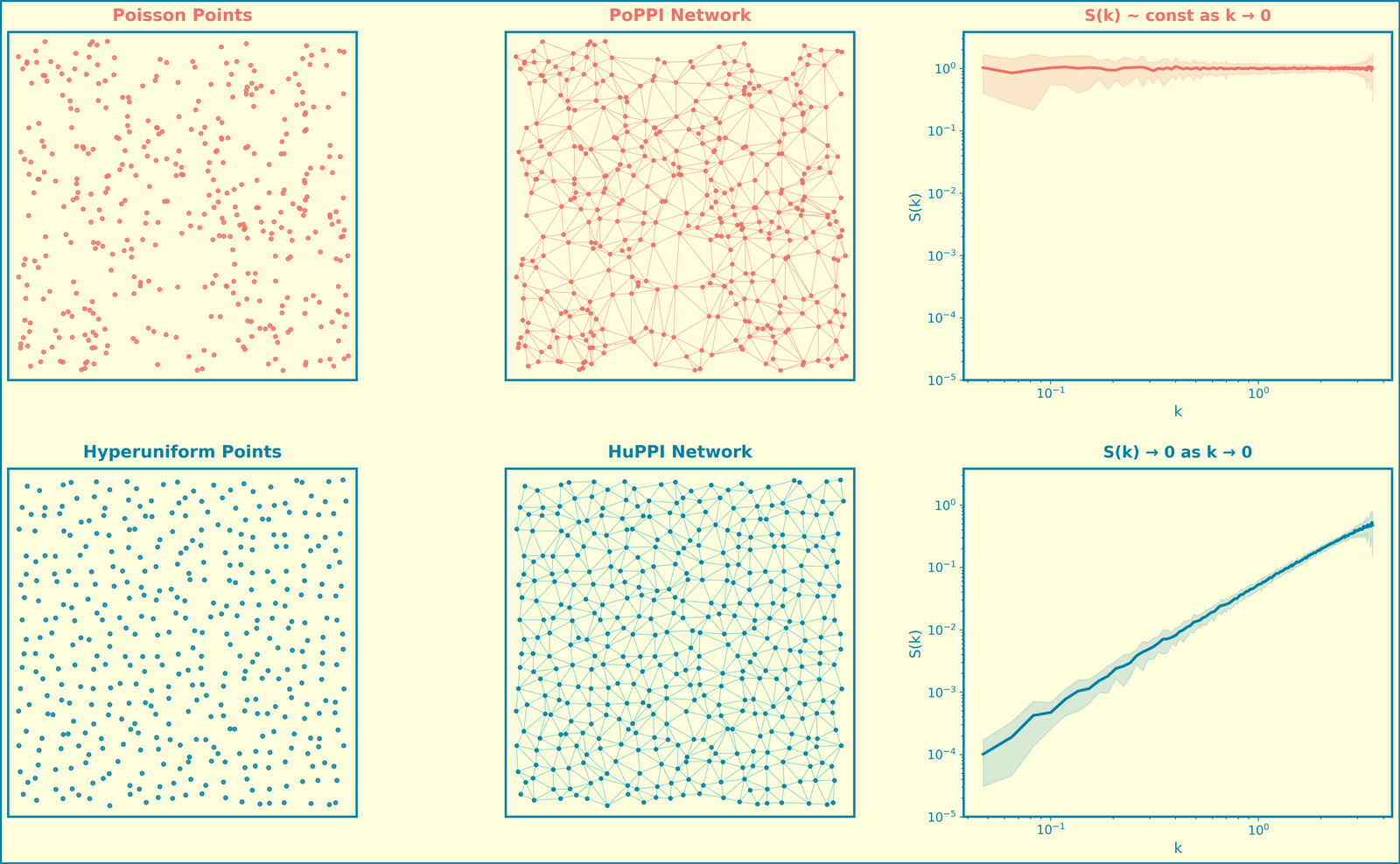
I am a 4th year Physics PhD student at UCLA working with Mason Porter. My research focuses on networks that arise from physical systems. For example, I study networks generated from hyperuniform point patterns, which are disordered arrangements of points that suppress large-scale density fluctuations (see figure below) and appear in settings ranging from leaf vein networks to the large-scale distribution of galaxies. I also study networks extracted from scale-rich metamaterials, which are engineered structures with elements spanning many length scales. I use tools from network science, topological data analysis (TDA), and statistical physics to understand how the structure and connectivity of these networks shape their transport and mechanical properties.
I am also interested in physical learning, where physical systems such as resistor networks are trained to perform computational tasks through local adaptation rules, and in persistent homology, a technique from TDA for detecting multi-scale structure in data.
Current Research
Many network-based physical systems, from spring networks to electrical circuits, can adapt themselves through purely local interactions, with no centralized control and no global signal indicating the desired output. We study how the underlying network topology shapes what such local rules can achieve. As a concrete case, we consider opening a phononic band gap on a disordered mass-spring network using a strictly local update rule. Whether the system succeeds depends heavily on the network. Spatial Delaunay and Watts-Strogatz networks typically succeed, while Erdős-Rényi networks mostly fail. These results point to network structure as a fundamental determinant of what local-rule physical learning can achieve.
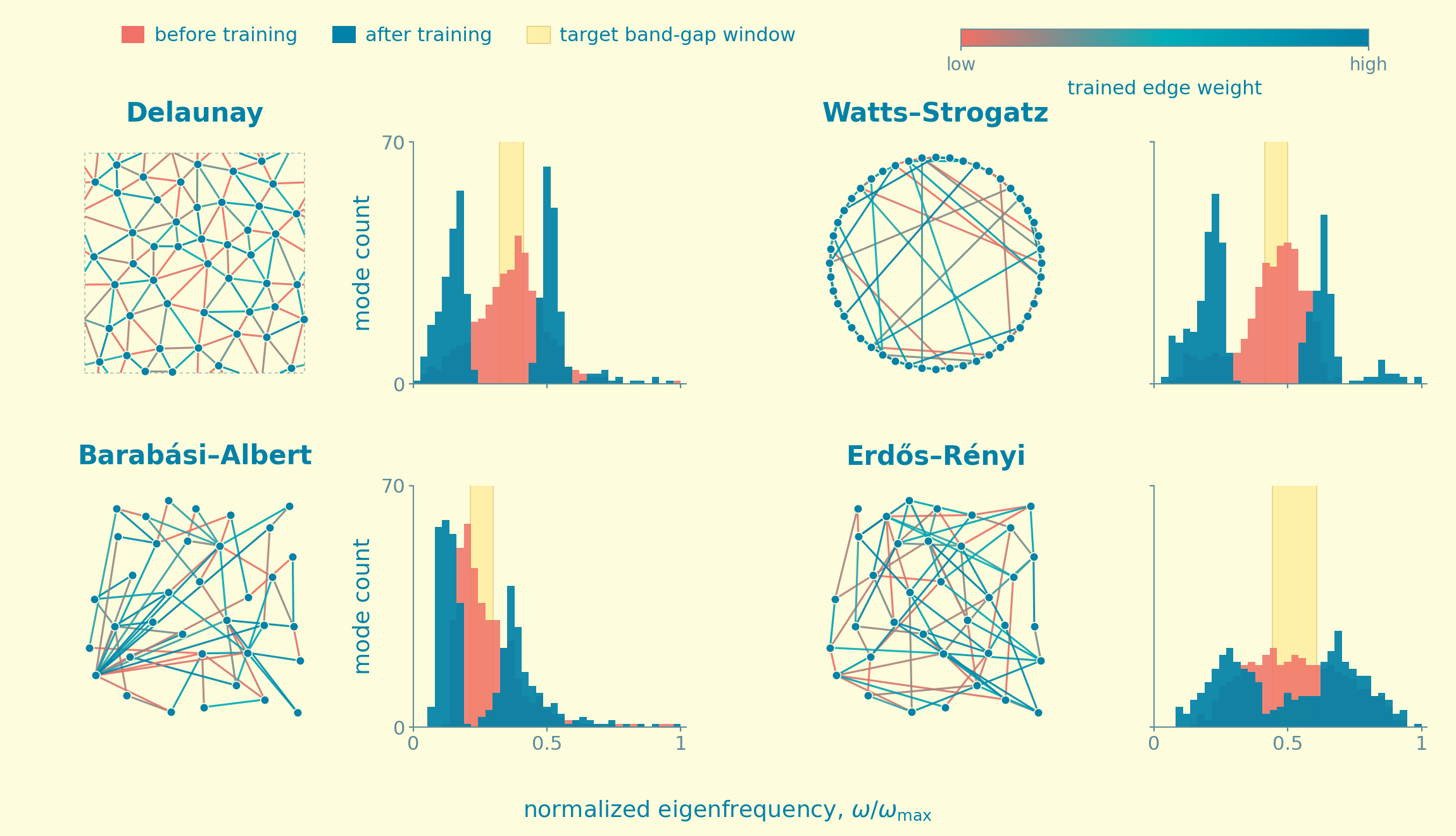
Eigenfrequency distributions before and after training for one representative run on each of four network families, with the target band-gap window highlighted. The diagram beside each histogram shows the corresponding trained network, with edge thickness proportional to the learned weight.
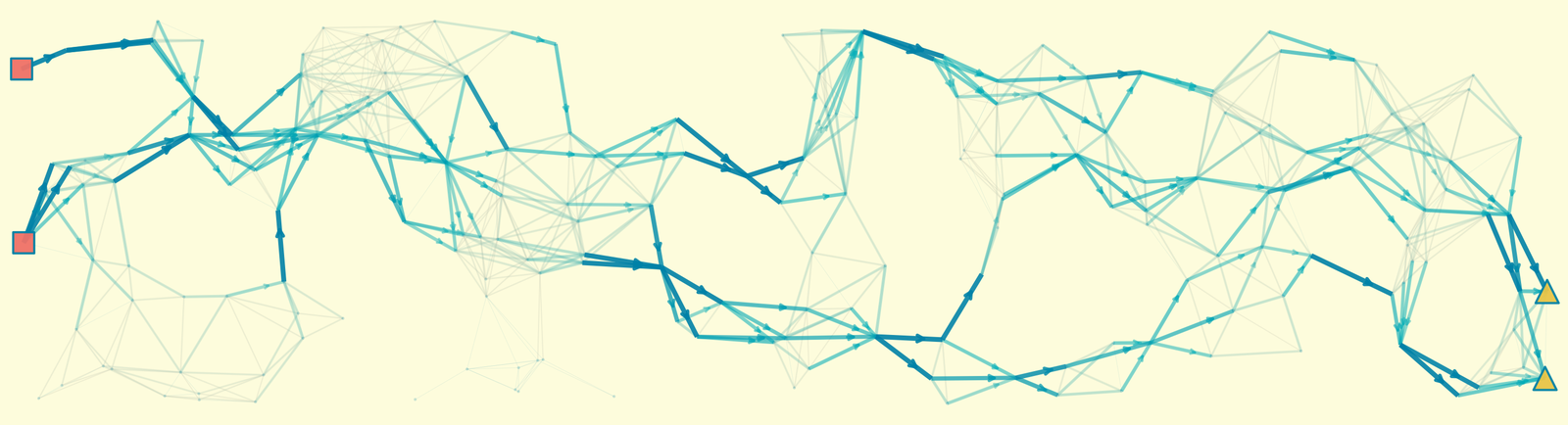
Scale-rich network-based metamaterials (Both et al., 2025) are engineered structures built by placing ligaments with power-law-distributed thicknesses and lengths. I develop a novel network formulation for these structures, where edge weights correspond to axial conductances derived from beam mechanics, making the graph Laplacian equivalent to the mechanical stiffness matrix. Using this formulation, I derive analytic bounds on transport properties like directional effective resistance and anisotropy, and study Anderson-like localization in the Laplacian spectrum, where vibrational modes become spatially trapped as structural heterogeneity increases.
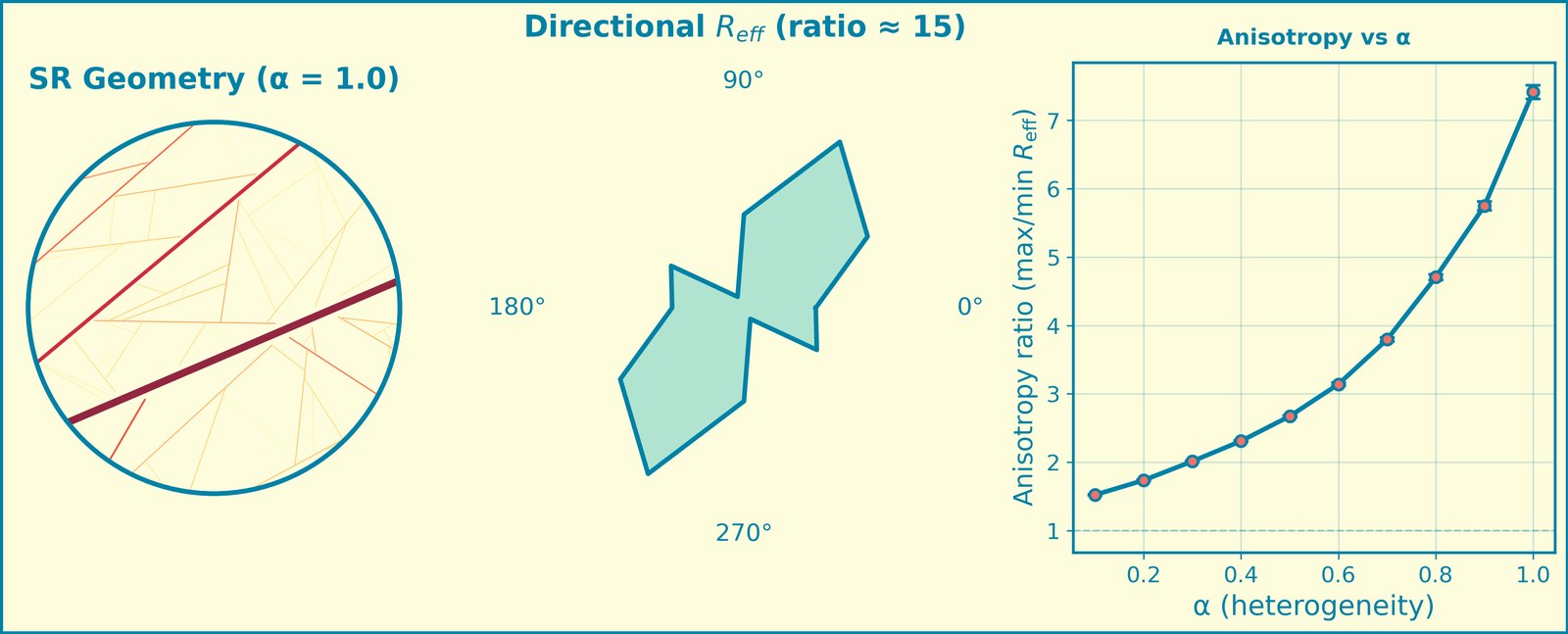
Directional effective resistance becomes increasingly anisotropic as the heterogeneity parameter α grows. Polar plots show Reff measured along 6 directions; the rightmost panel summarizes the anisotropy ratio (max/min Reff) across α values.
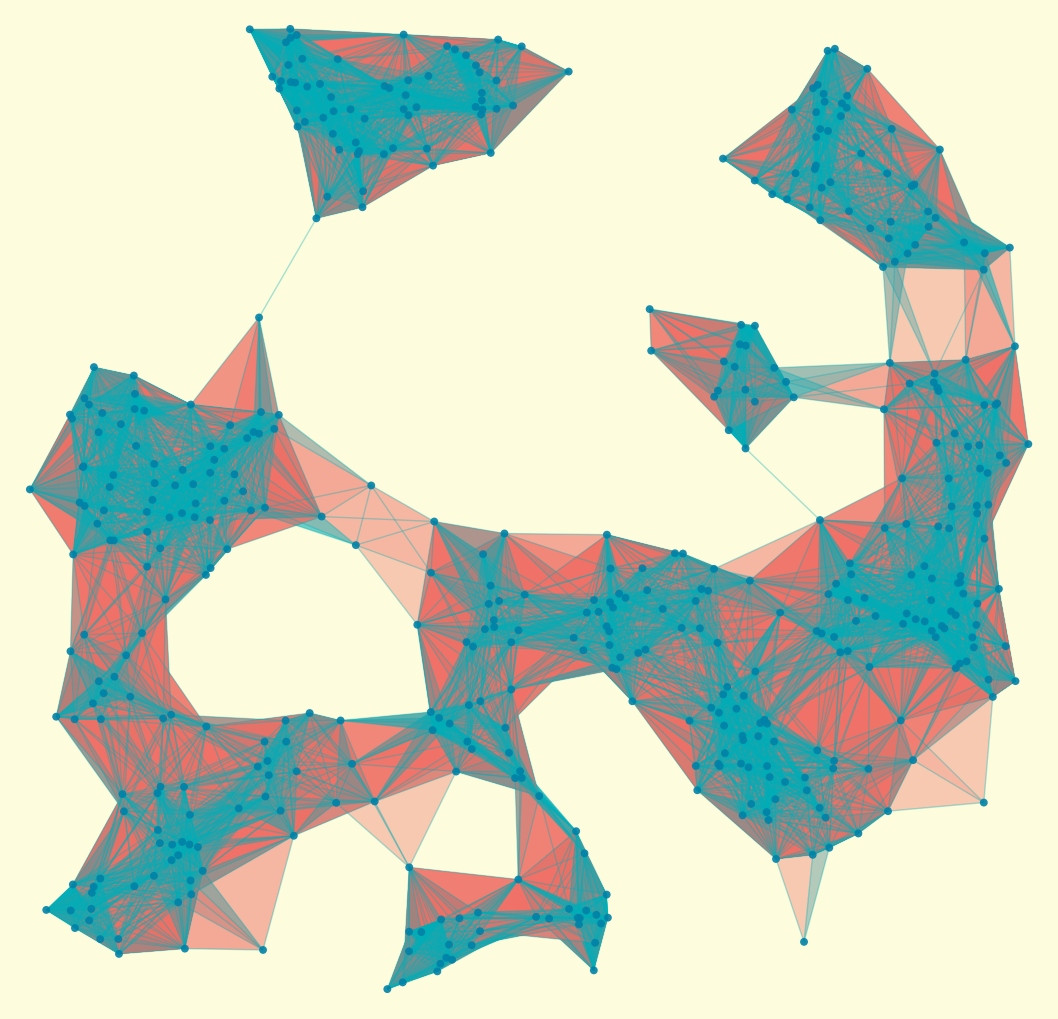
Topological data analysis (TDA) applies ideas from algebraic topology and computational geometry to study the shape of data. We use TDA to detect clustering at multiple scales in spatial point patterns, such as distinguishing tightly packed clumps from loosely spread ones, and connect these topological signatures to classical statistical physics measures of correlation and connectivity.
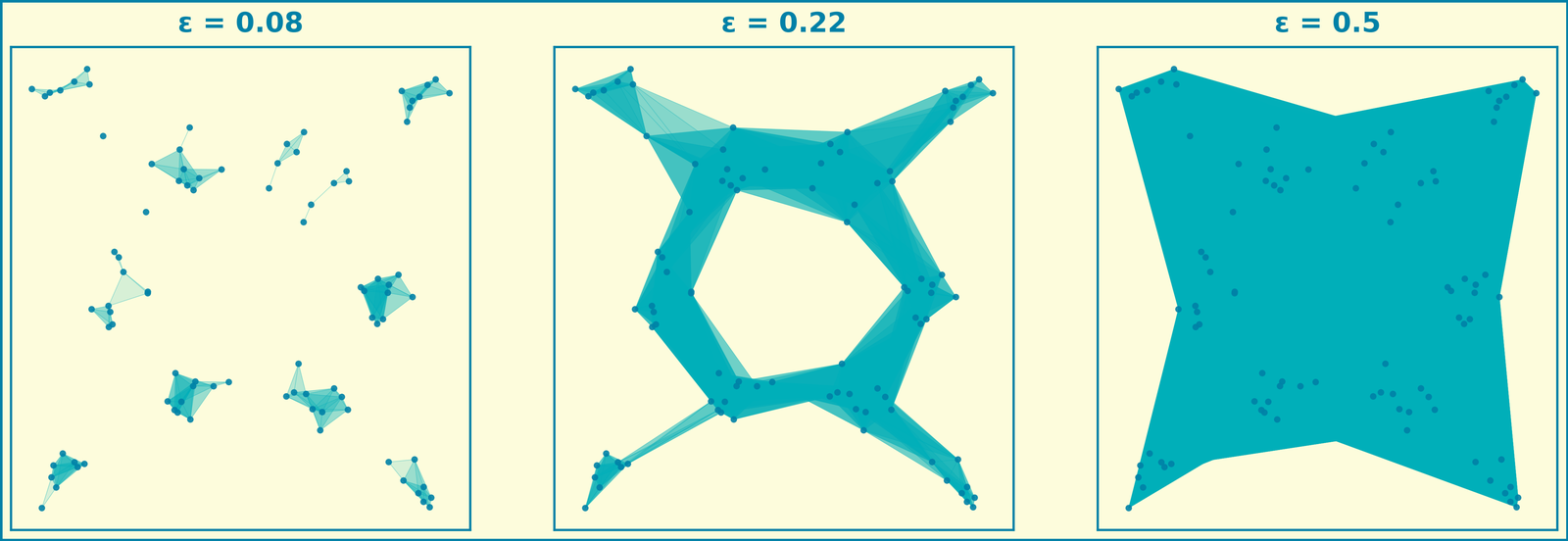
A clustered point pattern and its Vietoris-Rips simplicial complex at increasing filtration radius ε. As ε grows, local clusters connect and topological features (loops, voids) appear and disappear. Persistent homology tracks these changes.
Publications
Personal
Hobbies
I love baking! I make everything from sourdough and pizzas to croissants, brioche rolls, cookies, and all sorts of other things. I enjoy making a lot of the recipes from Claire Saffitz's YouTube channel. I'm also really into chess, both playing and watching. My peak rating is 2150 on Chess.com Rapid, though I try not to think about where it is right now.
Music
Some of my favorite artists are yeule, Sufjan Stevens, Quadeca, Jane Remover, Porter Robinson, and Alex G. If I had to pick one album, it would be Sufjan Stevens' Carrie & Lowell. If you haven't listened to it, I'd really recommend it. See more of my favorite songs →
Contact
Office: Mathematical Sciences (MS) 7611